Species / Berberidaceae
Berberis oblonga
Berberidaceae · Shrub · Uzbek: cho‘zinchoq bargli zirk, qora zirk, qoraqand; Russian: Барбарис продолговатый
Restoration use by landscape
West Tian Shan Pilot score 72 · rank 61 of 79 shortlisted · rank 77 of 1 194 scored
- Succession role
- Nurse / intermediate shrub
- Suited to
- Eroded slopes; Rocky slopes; Landslide-prone areas; Gullies & drainage lines; Degraded walnut–fruit and broadleaf woodland (other); Degraded juniper woodland
- Establishment
- stratified seed or cuttings; nursery
- Why this category
- Strong: erosion control potential; -> promising but propagation/supply or field performance not proven at scale: pilot plots
- Local habitat
- Rocky areas, Grassland · Occasional
Criteria scores
Propagation
stratified seed or cuttings; nursery
Planting combinations
- West Tian Shan: Degraded walnut–fruit and broadleaf woodland (northern slopes, valleys, ~1,000–2,000 m) (Phase 2)
Planting material and suppliers
| Supplier | Material | Quantity | Price | Source |
|---|---|---|---|---|
| Boysun SFE | Seedling (Barberry (zirk)) | 5 000 pcs | 12 000 UZS per piece | Table 7.5 |
Description
- Morphology
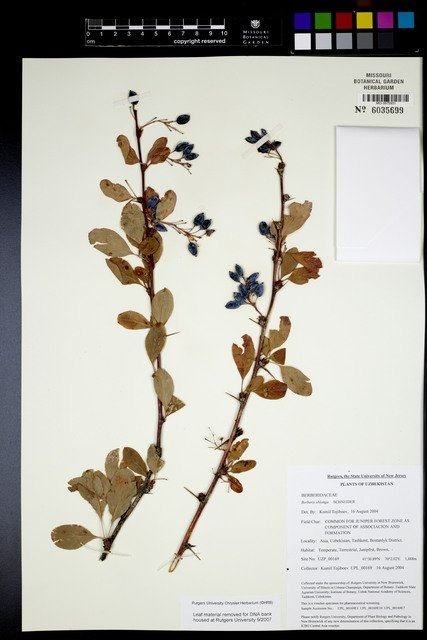
- Shrub, 2.5m tall, branching; young branches brown, turning gray when old; spines simple or tripartite, 15 mm long; leaves obovate, oblong or elliptic, 6 cm long, membranous, grayish green above, glaucescent beneath, tapering into a petiole, with entire or slightly dentate margin; flowers 1 cm in diameter, usually 10–20,rarely more in branching paniculate racemes; pedicels 8mm long; ovary oblong, with 1–3 ovules, short-pediceled; berries black with glaucous bloom, oblong-elliptic, 1 cm long, not more than 6mm broad; usually with single seed. May. [Flora of the USSR (Tree of Life)]
- Habitat
- Gravelly, stony slopes, screes, deciduous forest, juniper woodlands, pebble beds, valley of river
- Altitudinal belts
- Foothills, low mountains, mid-mountains, high mountains
- Phenology
- Flowering Apr–May, fruiting Aug–Sep
- Distribution
- Tian Shan (excluding Trans-Ili Alatau and Chu-Ili mountains), Pamir-Alai
- Uses
- forest amelioration / agroforestry, dye, food, medicinal, melliferous, ornamental
- Conservation
- IUCN NE