Species / Lamiaceae
Ajuga turkestanica
Lamiaceae · Subshrub · Uzbek: Turkiston ayugasi; Russian: Живучка туркестанская
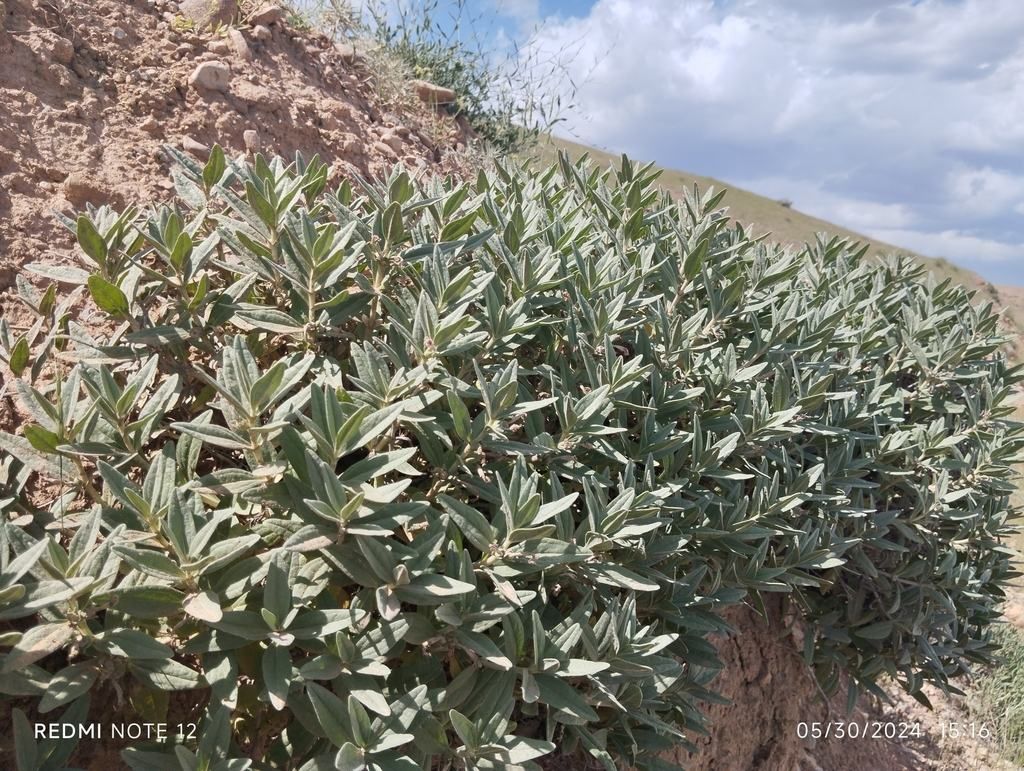
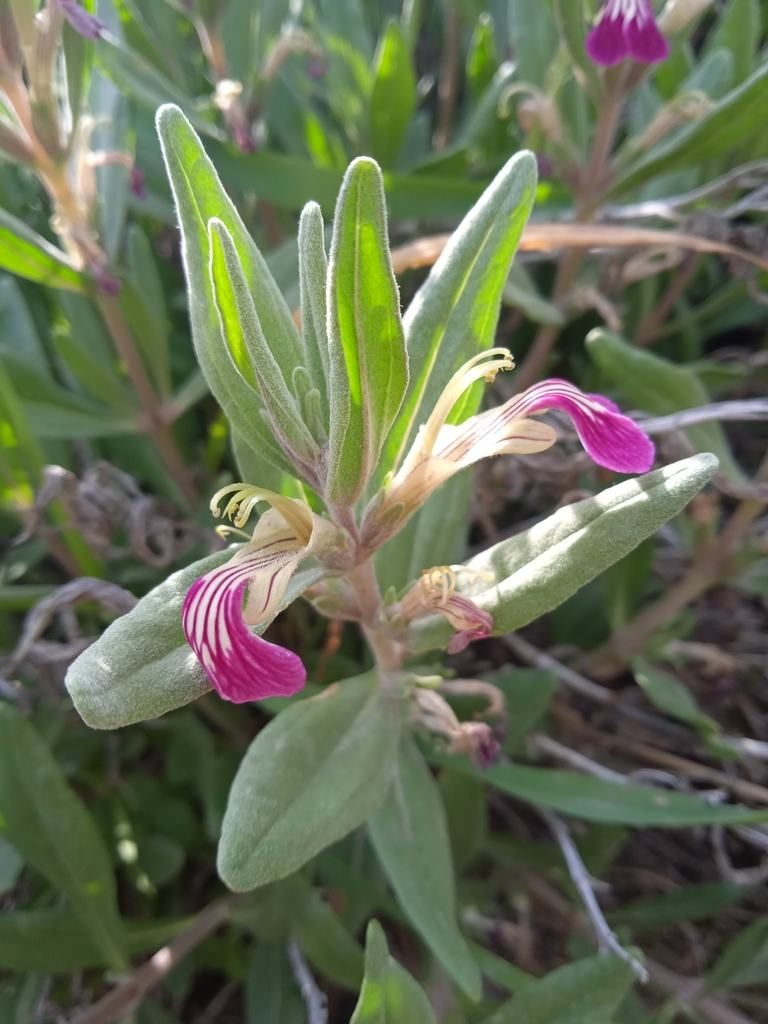
Restoration use by landscape
Kugitangtau Pilot score 72 · rank 74 of 100 shortlisted · rank 86 of 1 208 scored
- Succession role
- Pioneer (ground cover)
- Suited to
- Eroded slopes; Rocky slopes; Degraded pistachio–almond woodland
- Establishment
- seed (protocol to confirm)
- Why this category
- Strong: drought tolerance; Weak: grazing tolerance; -> promising but propagation/supply or field performance not proven at scale: pilot plots
- Cautions
- protect from grazing for 3-5 yrs
- Local habitat
- Artificial terrestrial, Grassland, Rocky areas · Frequent
Criteria scores
Propagation
seed (protocol to confirm)
Planting material and suppliers
No commercial offer found in November 2026: material has to come from wild seed collection or contracted propagation. See Nurseries & supply.
Description
- Morphology
- Subshrub with a robust root; stems 40-50 (60) cm long, stout, 3-5 mm in diameter, pale brown, sometimes reddish, rarely more or less whitish below, glabrous, grayish, in upper part finely and softly appressed-hairy like the leaves; leafless, woody and spinous branches usually absent; sterile shoots leafy above; leaves larger than in the preceding species, (30) 45-60 mm long, (12) 14-18 mm wide, oblong-elliptic or obovate, sometimes rhombic, only on short sterile branches occasionally oblong-lanceolate, entire or rarely with 2-4 apical teeth, tapering at base; lower leaves short-petioled, the upper sessile, amplexicaul; pubescence of leaves and other parts sparser than in the preceding species; flowers 25-40mm long, purple; pedicels 3-4 mm long at flowering, later 6 mm; calyx campanulate or narrowly so, (8) 10-12 mm long at flowering, 13-16 mm in fruit, covered all over with fine short appressed hairs, glaucous, the teeth narrowly lanceolate, nearly as long as calyx-tube, accrescent in fruit to nearly twice their length and becoming broadly lanceolate, foliaceous; corolla-tube long, b. [Flora of the USSR (Tree of Life)]
- Habitat
- Outcrops of variegated rocks, fine-earth, gravelly, stony slopes, rocks
- Altitudinal belts
- Foothills, low mountains, mid-mountains
- Phenology
- Flowering Apr–Jul, fruiting May–Jul
- Distribution
- Pamir-Alai (ranges Hissar and its southwestern spurs, Darvaz, foothills of southern Tajikistan, Kugitang)
- Uses
- medicinal
- Conservation
- IUCN NE